What is TOPCon PV technology? Is it worth investing in?
A classic monocrystalline photovoltaic (PV) panel is a solar energy device made of silicon crystals arranged in a uniform, single-crystal structure. These cells are cut from cylindrical silicon ingots, resulting in their characteristic rounded or chamfered edges. Renowned for their high efficiency and sleek, uniform black appearance, monocrystalline panels marked a significant advancement over polycrystalline PV panels, which use multiple silicon crystals and are comparatively less efficient.
While monocrystalline technology was already a major improvement, the photovoltaic industry has continued to innovate, with a clear focus on developing new technologies to further enhance efficiency and performance. Among recent innovations, TOPCon (Tunnel Oxide Passivated Contact) technology has emerged as a viable solution for commercial application. Although foundational research and development of this technology started in the late 2010s, it wasn’t until 2019 that large-scale production and market availability gained significant shape. By 2020 and 2021, TOPCon modules had become a leading traction as major manufacturers embraced this innovative approach to enhance the efficiency and performance of photovoltaic systems.
But, what is exactly this “new” technology?
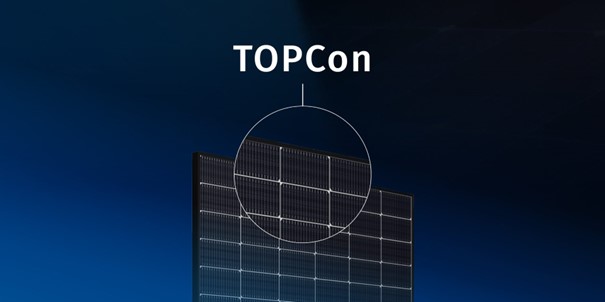
TOPCon (Tunnel Oxide Passivated Contact) technology is an advanced innovation designed to improve the efficiency and performance of solar cells. It builds upon the traditional monocrystalline silicon cell architecture by introducing a specialized passivation layer and conductive structure that minimize energy losses and enhance charge carrier management.
The technology incorporates a thin, ultra-pure tunnel oxide layer on the back surface of the silicon wafer, followed by a layer of doped polysilicon. The tunnel oxide acts as a barrier that minimizes the recombination of charge carriers (electrons and holes), while the polysilicon layer facilitates efficient conduction of electrons. This dual-layer approach enhances passivation and improves electron flow, enabling TOPCon cells to achieve significantly higher energy conversion efficiencies, with rates up to 24%, in comparison with traditional monocrystalline cells, that typically achieve efficiencies in the range of 20%-22%. What’s more, Topcon technology has a transparent backside – unlike “standard” cells with opaque layers – which greatly enhances photon capture through improved internal reflection. Thus, this improves strongly the performance of these modules under low irradiation.
Is it worth investing in this technology?
As of recent data, the pricing for solar panels in Europe varies depending on factors such as brand, efficiency, and purchase volume. Monocrystalline panels are generally available at prices ranging from 0.100€ to 0.115€ per Watt. In comparison, the average price for TOPCon modules in Europe is approximately 0.104€ per Watt, with variations between 0.090€ and 0.122€ per Watt1. Although TOPCon modules are slightly more expensive than traditional monocrystalline panels at the outset, their enhanced performance can justify the extra investment. Laboratory tests have also shown that the degradation of the cells, and therefore the intrinsic performance of these panels, has improved, enabling long-term optimization of PV generation projects and offsetting the slight extra cost of these cells.
Conclusion
TOPCon technology represents a key advancement in photovoltaic panel design. While they are more expensive upfront compared to traditional monocrystalline cells, the enhanced efficiency, extended lifespan, higher temperature tolerance and superior low-light performance in different conditions, offer better energy production and long-term benefits. They are an attractive option for long-term renewable energy solutions, where durability and maximum energy output are priorities. With the development of renewable energies, TOPCon technology will make a sustainable and effective contribution to meeting the world’s energy needs.
Written by Paula Ortega and Imane Alil
The Latest Renewable Energy News

Greensolver unveils a new brand identity and website to better serve renewable energy stakeholders

PRESS RELEASE – Greensolver Reinvents Its Brand Identity to Deliver Environmental and Financial Value